
I’ve been messing around with games for as long as I can remember. As a kid, I’d spend hours making up my own rules, just to see what would break. I didn’t care about winning. I wanted to know why things worked the way they did.

That curiosity stuck with me. Games showed me that every choice shifts the balance, that fairness is complicated, and that the rules matter more than we think.
When I went to university, I studied game development. I wanted to build things that taught people something real. Around that time, I discovered Games for Change, where designers used play to spark actual conversations about hard stuff—empathy, justice, how we treat each other. It clicked. Games could do more than entertain. They could make us think.
After graduating, I worked in education as an in-house developer. I thought it’d be mostly technical work, but instead I found myself surrounded by human problems—teachers trying to do right by their students while juggling impossible demands, schools trying to figure out what actually matters. As AI started showing up in classrooms, those problems got messier. Privacy, fairness, trust. All fuzzy concepts, all urgent.
I wanted a way for people to wrestle with these questions without it feeling like a lecture. So I built this game.
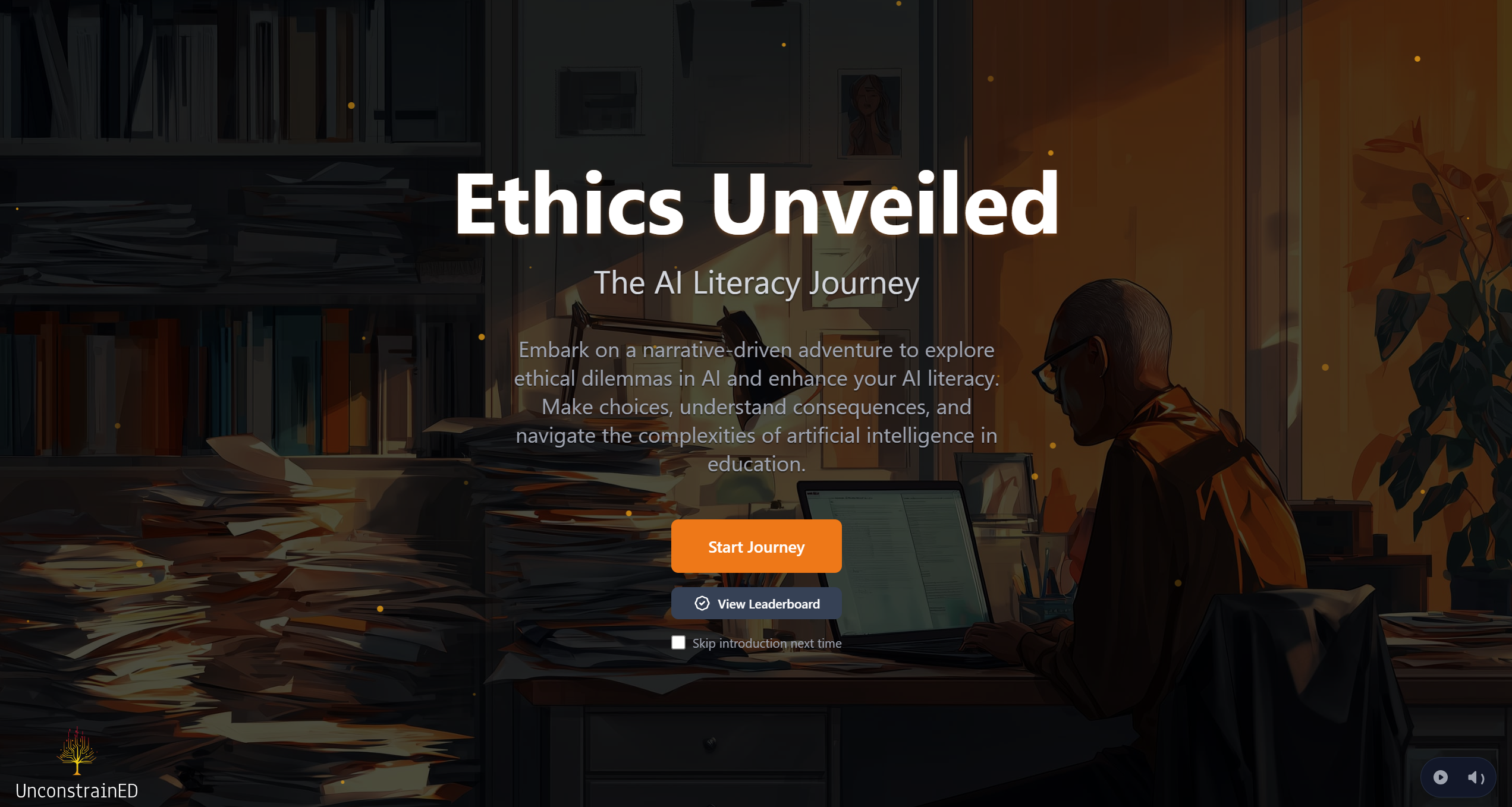
Ethics Unveiled: The AI Literacy Journey

Ethics Unveiled is a digital card game about AI in education. You make decisions that matter and watch consequences unfold. There’s a scoring system if you want it—my wife reminded me that some players need that leaderboard—but the real work happens in the reflection.
Each round starts with a real classroom dilemma. You pick a role—teacher, parent, policymaker, student—and face a situation with no clean solution. You play cards that represent actions. Protect privacy. Push for innovation. Build trust at the cost of time or money. Every choice shows you the tradeoff.
The narrative shifts based on what you do. No two playthroughs are the same. When the scenario ends, you see what happens next. Months later. Years later. Sometimes you feel good about your choice. Sometimes you don’t. That’s the point.
How It Feels to Play
The game moves slowly on purpose. The design is calm. There’s space to think.

It makes abstract ethics concrete. You see your impact on others. You can replay scenarios and try different paths, but the story will branch differently each time. Question, decide, reflect. The rhythm mirrors how real learning works.
What We’re Learning
I’ve been running Ethics Unveiled with educator cohorts as part of our UnconstrainED training. It’s become one of the most powerful parts of the experience. Teachers play through scenarios together, then talk about why they made different choices. Those conversations get real fast.

The game keeps evolving based on what people tell us. What confuses them. What hits home. What they wish they could do differently.
I can see this working with older students, parents, and educators. Anyone who needs to think through what AI means in their school community.
Why Games
Games help me understand things. They let you fail safely and reward curiosity. You can test ideas and watch what happens.
Ethics usually lives in abstraction. Games force you to get specific. They turn empathy into practice.
That’s what Ethics Unveiled does. It’s a space to play with hard questions and remember that every system is just people trying to figure things out.

Try It
If you want to experience the game yourself or bring it to your school or organization, email me at alex@unconstrained.work.
Your feedback will help shape where this goes next.



Leave a Reply