
Last week I was talking with a tech director and friend at a school. We were comparing notes on his budget — devices, platforms, the annual SaaS pile. None of it small.
Then he mentioned wanting to bring training in. Specifically the upskilling side — the human work of getting AI used well in his building. And the conversation shifted. Suddenly we were talking about how to justify it. How to explain it. How to convince a board that this line item is worth a fraction of what they’d already approved for the tools themselves.
It struck me as ironic. Frankly, it’s ridiculous.
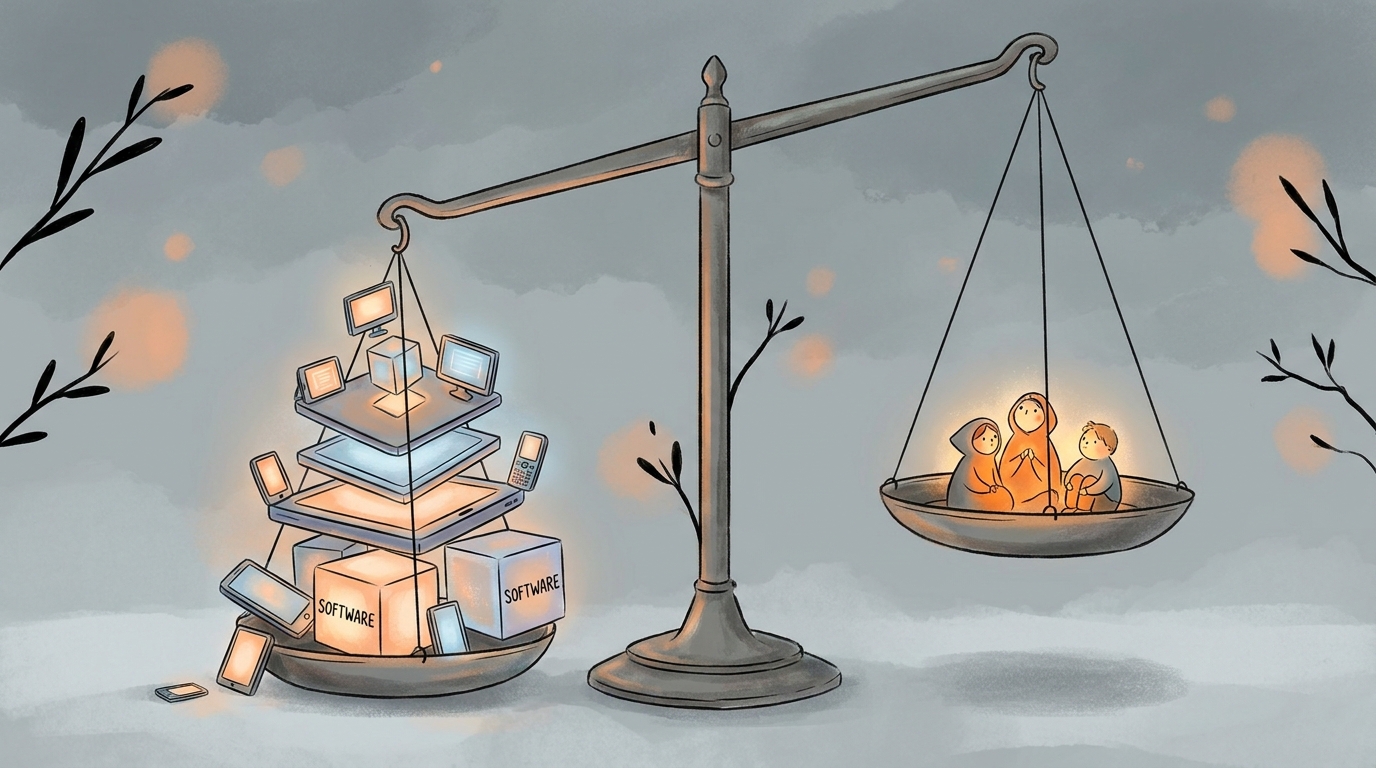
We’ll approve a six-figure platform without blinking. Then hesitate at a fraction of that for the people who’ll actually use it.
The research is telling us the exact opposite of what our budgets are doing.

The Math No One’s Doing
BCG put a number on this in their 2026 report AI Transformation Is a Workforce Transformation. The headline: organizations need to spend $2 to $3 on workforce reskilling for every $1 they spend on AI tools to realize the productivity gains the deployment was supposed to deliver. Two to three times as much on the people as on the platform.
Most schools — and most organizations — are nowhere near that ratio.
We keep coming back to MIT NANDA’s State of AI in Business report — 95% of enterprise GenAI pilots fail to deliver value. The number bears remembering because the underlying cause hasn’t changed: the failure mode isn’t the technology. It’s the learning gap. Employees are left to experiment on their own. Shadow AI fills the vacuum — Audry wrote about exactly this dynamic a couple of weeks back. The gains don’t show up.
Microsoft and LinkedIn’s most recent Work Trend Index shows the same pattern at population scale. 75% of knowledge workers are using AI at work. Only 25% of organizations are training them on it.
That’s the gap. Three quarters of the people using these tools are figuring it out alone. The research is unanimous: the limiting factor isn’t access to AI. It’s the human capacity to use it well.
And we’re funding the wrong side of that equation.

Let’s Do the Math
Let me show you what this looks like in actual dollars.
A 200-person organization buying Microsoft 365 Copilot at $30 per seat per month spends $72,000 a year on that one AI feature. Add ChatGPT Enterprise for a smaller power-user group — say 50 seats at $60 a month — and that’s another $36,000 a year. Layer on the existing SaaS pile (base Microsoft 365 or Google Workspace, the LMS, the video tools, whatever specialty platforms your team relies on) and a typical mid-sized org is moving $150,000 to $250,000 a year just on tooling.
I want to be direct about something. The conversation I had was with a school. But this math doesn’t change because of what business you’re in.
A 50-person professional services firm. A 500-person nonprofit. A 2,000-person enterprise. The pattern is the same: tooling line items measured in the hundreds of thousands or millions, training budgets measured in tens of thousands at best. Most organizations I work with are spending more on a single SaaS contract than on their entire annual learning budget.
Now apply BCG’s ratio against those numbers.
That 200-person org spending $108,000 a year on AI licenses alone — by BCG’s research, they should be putting $216,000 to $324,000 a year into reskilling to actually realize the gains those licenses are supposed to deliver. The 1,000-person enterprise paying ChatGPT Enterprise alone — $720,000 a year — should be investing $1.4 to $2.2 million in their people on top of that.
Most aren’t even close.
That’s the gap the research is pointing at. And it doesn’t matter whether you’re running a school district, a hospital, a bank, or a 50-person consultancy. The math is the same. The math is also unforgiving.

What That Money Actually Buys
Most leaders I talk to assume training is a check-box exercise. Send people to a workshop, hand them a slide deck, hope they remember. The line item gets cut first because nobody can quite explain what they got for it last time.
That’s a fair concern. Bad training is a waste of money. Good training is something else.
What we see when reskilling is done well is that organizations don’t just get more confident AI users. They get judgment.
People learn when to reach for AI and when not to. When to trust the output and when to verify it. How to write a prompt that does the thinking for them versus one that hands the thinking off entirely. They learn the difference between AI as a fluent guesser and AI as a defensible thinking partner — and they build the habits that make the second possible.
That last part matters. The EU AI Act puts education in the same high-risk tier as healthcare and justice — and they’re right to. A flawed AI recommendation in a classroom can shape a student’s trajectory in ways that don’t undo easily. The same kind of mistake in a hospital, a finance firm, or a legal practice carries its own version of the cost. Verification isn’t optional rigor in any of these settings. It’s the work itself.
The other thing reskilling buys, which doesn’t show up in any spreadsheet, is permission. People stop being scared of the tools. They stop hiding their AI use. The shadow economy of “I’m not supposed to but I am” disappears, and you get a workforce that can actually be honest about how they’re using AI — which is the only way you can manage it.
That’s not a slide deck. That’s culture change.

And This Gets Harder, Not Easier
Here’s the part that should keep this conversation going.
The math I’m describing is for the AI we have today — the chatbot-style tools you query, supervise, and edit. Agentic AI is already reshaping that picture. Systems that plan and act on their own. Workflows that fire without anyone in the loop.
A natural read of that shift is that you’ll need fewer trained humans. The opposite is true.
PwC forecasts 66% skill obsolescence in agent-exposed roles. Daron Acemoglu at MIT argues that the agentic phase favors workers who already have the judgment skills — and widens the gap for everyone else. The shift from “AI as tool” to “AI as autonomous teammate” doesn’t reduce the need for human judgment. It puts a much higher premium on it.
Which means the budget conversation we’re having now is the easy version. The harder one is coming.
I’ll be writing more on this, soon.

One Question to Sit With This Week
If you’re a leader making budget decisions about AI in your org, here’s the question worth sitting with:
For every dollar your organization will spend on AI tools next year, how much is it spending on the people who’ll use them?
Pull the actual numbers if you can. Then look at BCG’s ratio. Then decide whether your spreadsheet matches what the research says about what works.
We built a Workflow Audit template specifically for this kind of scoping. It’s free. Use it on your own.
I’m going to keep talking with my friend about his budget. The board meeting hasn’t happened yet. I don’t know how it’ll land. But I know what I’d argue if I were in his seat. And I know what the research is telling all of us.
The tools were the easy part. The people were always going to be the work.
If this is the conversation you’re having in your own org, I’d love to hear how it’s going. alex@unconstrained.work.
— Alex
Sources
- BCG (2026). AI Transformation Is a Workforce Transformation. Boston Consulting Group.
- MIT NANDA (2025). State of AI in Business 2025. The “GenAI Divide” research.
- Microsoft & LinkedIn (2024). Work Trend Index — AI at Work Is Here. Now Comes the Hard Part.
- PwC (2024). Hopes and Fears Survey — agent-exposed roles and skill obsolescence.
- Daron Acemoglu, MIT — Faculty page; widely cited 2024–2026 work on AI’s labor market effects, including warnings about widening skill gaps in the agentic phase.
- EU AI Act — official explainer of the regulation and its high-risk tier, which includes education.
- Audry Pallas (2026). How to Manage Shadow AI and Unlock Employee Innovation. UnconstrainED.




Leave a Reply