
The walls of art museums whisper stories of identity and ideas often expressed visually before they were wholly accepted. They are a testament to the human capacity for questioning and connection. For many, like myself, these spaces are sanctuaries that hold some of our fondest memories. When I was growing up in Dublin, I went to the National Gallery of Ireland for open art lessons on weekends. The gallery filled with children from all over Dublin who gleefully ran through the usually hushed spaces and lay on the ground with big pieces of paper, paints, and dreamy images. The rush of freedom and the beauty of the light-filled spaces on those weekends shaped me. Now, whenever I enter an art museum or gallery, I get that same rush of unconstrained joy.

Flash forward thirty years to Sao Paulo, Brazil. Os Gemeos, a street art duo based and beloved in Sao Paulo, were having an exhibit, and the gallery invited schools to visit for this and other collections. I was thrilled to chaperone.
The anticipation that I felt wasn’t shared by all of our students, and a few were doing their best to look anywhere but at the exhibits. I stayed by these detached students at the back of our group. As we toured the galleries, I let the swirl of colors and themes wash over me, and I tried to share my sense of wonder with my group of stragglers. My students were used to me by then and good naturedly looked closely at the installations we viewed and answered my questions.
Our guide, perhaps a bit annoyed by the chattering group I was ring-leading, looked at me and said, “O que você vê nesta pintura?” (What do you see in this painting?).
What do I see in this painting? I see a small purple home in the middle of a red storm, either being rocked by it or riding it to safety. I see my family in that house, safe inside – but are we being tossed by the swirl around us and we don’t realize it? I see my husband, my children, and I traveling through space and time like global nomads, and I worry that we don’t have ground to land on. As these thoughts churned, I tried to organize them into Portuguese to answer the guide. My language skills, at best, could be described as “playground Portuguese.” I talked to other moms about our children, movies, and food, but to describe the roiling feelings that this painting evoked in me was far beyond this. In my head, I still practiced every word I would say in Portuguese. I did not dream in Portuguese.
“As cores são tão vividas, roxo e vermelho…” I stumbled as the whole group looked at me amused.
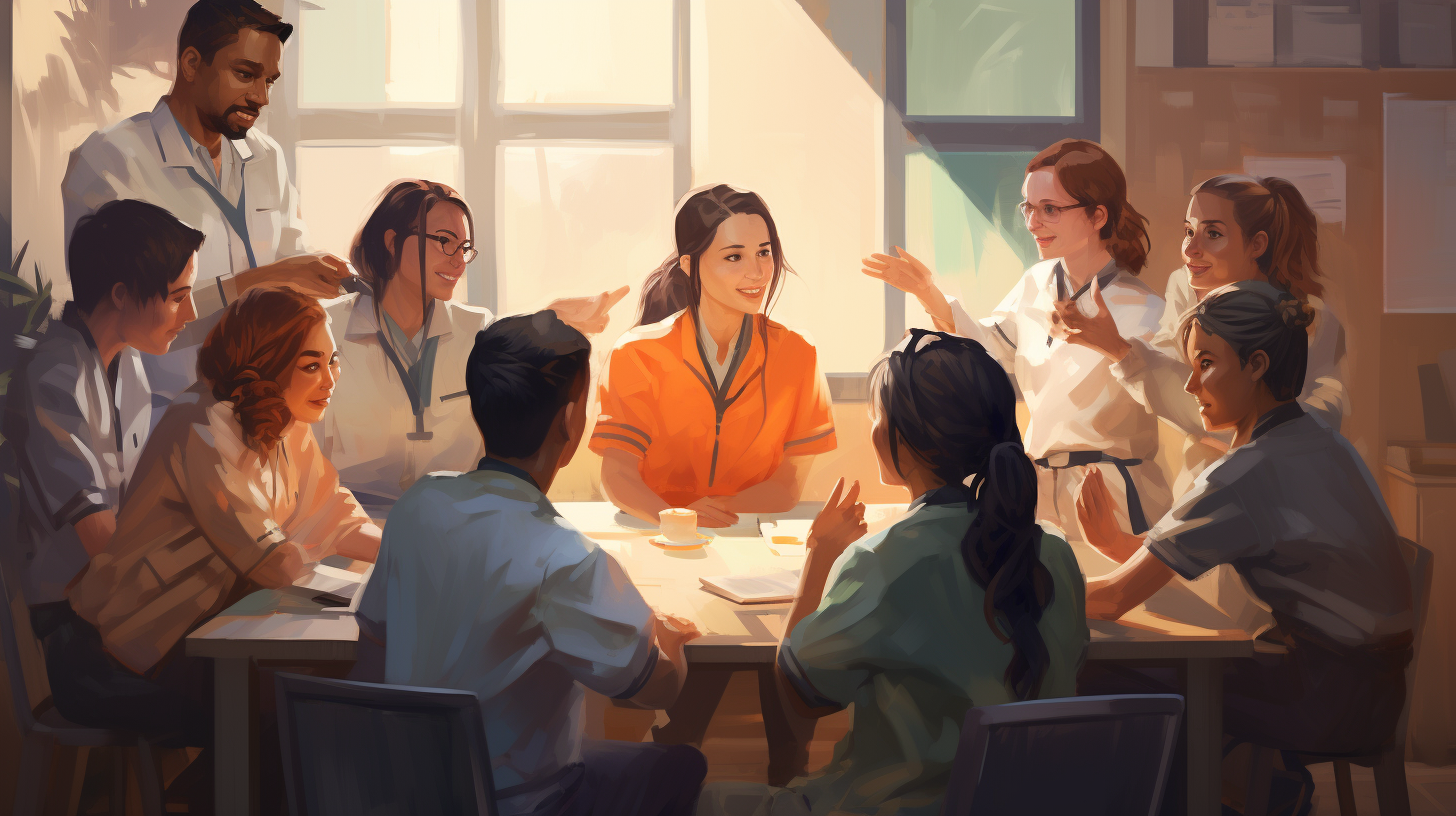
A student at my side-one who had originally tried her best to not be impressed by the art around her-one who was still learning English and tripped over expressing herself in class-looked at me. She whispered, “What would you like to say Ms?”
I looked at her with relief and tried to express what the painting made me think and feel. She turned to the group and translated, pointing to the parts I picked out, energizing my words with her arm movements. The guide nodded and moved us along to the next painting. The girl squeezed my hand and returned to her friends.
That student became my bridge to understanding and connection. It was empathy in action—a young mind and heart connecting with another, transcending language barriers, and transforming my disjointed thoughts into a narrative that she helped others to understand.
This moment encapsulates the essence of what artificial intelligence, for all its advancements, cannot fully replicate: the profound human connection borne out of empathy. AI can translate languages, predict behaviors, and simulate conversations, but it cannot feel the undercurrents of emotion that give meaning to our words. It cannot replicate the subtle, yet powerful exchanges like a reassuring hand squeeze that says, “I understand,” without uttering a single word.
As we integrate AI into our lives, especially in education, we must remember that it serves as a tool, not a replacement for the deep, empathetic connections that define our humanity. We absolutely should embrace the efficiency that AI provides while also fostering the emotional intelligence that can only be nurtured through human interaction.
Let us challenge ourselves to find the balance between where technology expedites our ability to communicate without losing sight of why we communicate in the first place – to share our thoughts, feelings, and dreams. In the classroom, in art galleries, and everywhere in between, we have the opportunity to model and teach the empathy that AI cannot. By doing so, we ensure that the heart of education beats as strongly as ever, even in an age where hearts and wires intersect.


Leave a Reply