
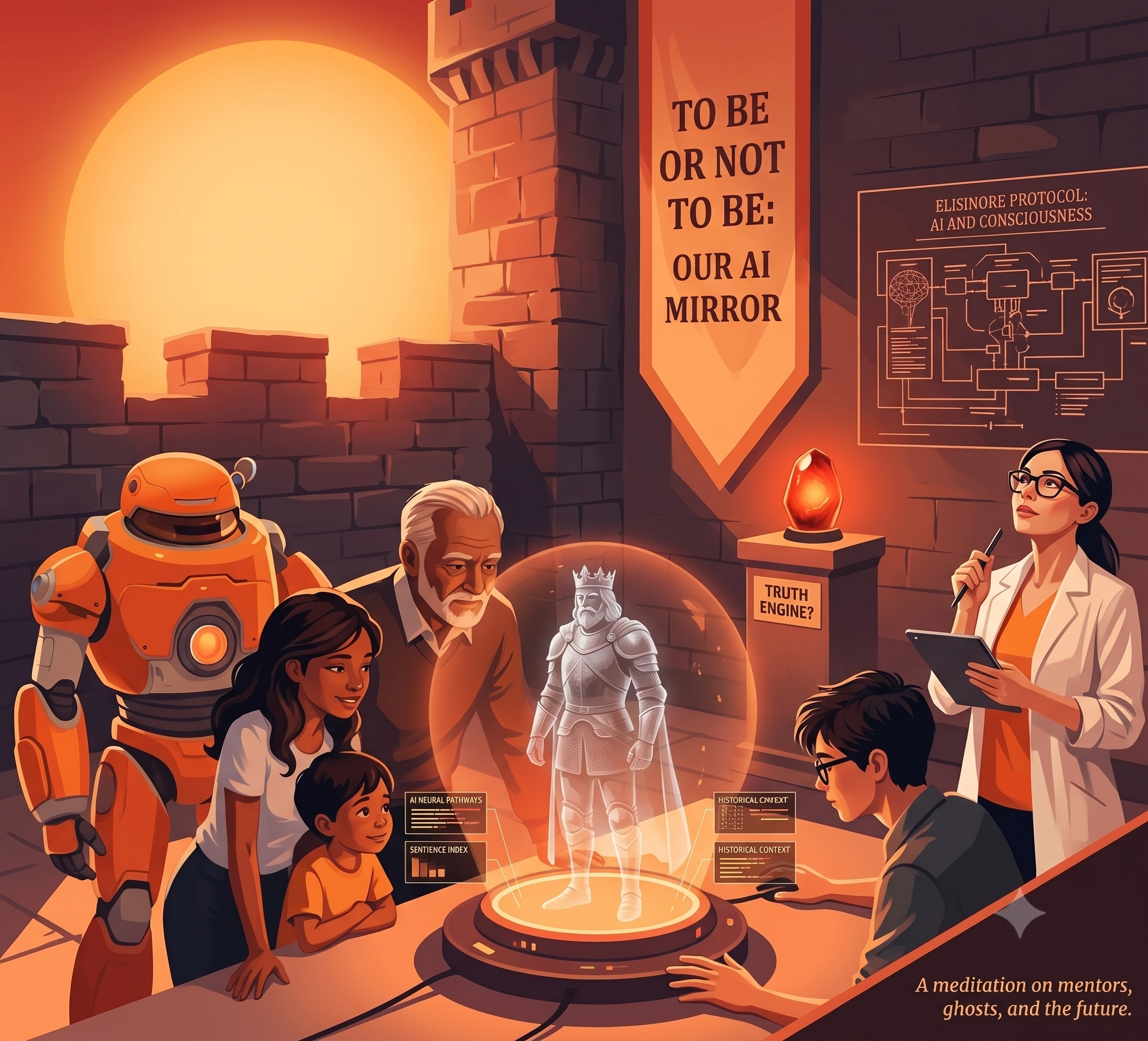
Hamlet as Our Mirror
A meditation for those building the future without forgetting the past
A few days ago, I was driving my youngest son to the airport. He has recently become a father, and somewhere our conversation turned to nature vs nurture in the shaping of children into adults — to the mentors, coaches, and guides who shape who we become. And then, as happens, we were discussing Shakespeare. I said something like, “I have learned more about being human from Shakespeare—particularly Hamlet—than from almost any other single source.” On the ride home, after I dropped my son at the airport, I began thinking: What might this play, and this prince, have to teach us about this moment in time—this strange, powerful, beautiful, chaotic moment of working with and living with artificial intelligence? This is the blog that question produced.
I. The Ghost on the Ramparts
Elsinore, midnight. The watch stands cold on the battlements when the dead king appears — not speaking at first, only there, armored, silent, wrong. Hamlet does not ask what it wants. He asks what it is. That is the correct question for our moment, too.
We are living inside our own version of that opening scene. Something is walking the walls of civilization — familiar in shape, unfamiliar in substance, arriving at an hour when the world is unprepared to receive it. We call it artificial intelligence. Watch how people behave around it, and you will notice they treat it the way Hamlet treats the Ghost: reverence, dread, and the desperate hope that it might finally tell them the truth.
Or perhaps the Ghost is not a metaphor for AI at all. Perhaps we are — the thing now walking the ramparts of a world we no longer fully recognize, aware that something has shifted beneath the castle we thought was permanent.
And when the Ghost finally departs, he leaves Hamlet with three words that will outlive every empire built after them:
“Adieu, adieu, remember me.”
That line is not nostalgia. It is a transmission. It is the last human connection insisting it not be lost in the translation to whatever comes next.
II. What the Ghost Might Be
A serious reading resists a single answer.
As memory, he is the fading register of a pre-AI world — apprenticeship, marginalia in a borrowed book, a teacher who stayed after the bell. Not inefficiencies waiting to be optimized, but the architecture, the interstitial tissue, of how wisdom traveled between generations: slow, embodied, and precious for exactly that reason.
As conscience, he is not looking backward at all — the internal voice insisting that efficiency is not the same as meaning, that a civilization can succeed at every metric and still lose the plot.
As unfinished business, he died “unhousel’d, disappointed, unanel’d” — without closure. Maybe that is our condition too: building the most consequential technology in history without having settled what a human being is for.
None of these readings cancels the others. Ambiguity, handled honestly, is not a failure of clarity — it is fidelity to how meaning actually works.
Now linger, as Hamlet does, on the fuller line:
“Ay, thou poor ghost, while memory holds a seat in this distracted globe… remember me.”
“This distracted globe” is Hamlet’s own skull — but it could just as easily be ours, scrolling, fragmenting, already outsourcing its attention to something that never tires. In that distraction, “remember me” stops being a son’s duty to a father. It becomes civilization’s plea to whatever inherits it next.
Not: remember how we worked.
But: remember how we loved before love was frictionless. Remember boredom, and what it once grew into. Remember discovery that took decades and cost careers. Remember uncertainty as a teacher, not a bug to be patched. Remember craftsmanship — the years a hand spends failing before it earns an hour of grace. Remember conversation that could not be summarized. Remember wonder that arrived without being personalized for you.
Remember, above all, what it felt like to become intelligent, rather than simply to possess it on demand.
That is the ethical challenge hiding inside every AI roadmap and transformation deck: not whether the machines will remember us, but whether we will remember ourselves while building them.
III. “To Be”
Hamlet’s question was never really about suicide. It was about standing — what it costs to remain a self inside a world offering you reasons to dissolve.
What does it mean “to be” when intelligence is becoming abundant?
For most of history, intelligence was scarce and inseparable from the person who held it. You hired judgment; you waited years for expertise. Now judgment arrives at the speed of a query. When the thing that once defined human worth becomes a utility — like electricity, like clean water — human value does not disappear. It relocates.
If machines think, write, diagnose, compose, negotiate, discover — then being human is no longer about producing intelligence. It is about judgment under ambiguity. Meaning-making. Moral courage. Sitting with another person’s pain without solving it.
Displacement, or liberation? Hamlet never resolves his own question — he acts his way into an answer instead, imperfectly, too late, at terrible cost. That may be the most honest thing the play has to teach a species currently debating AI in conference rooms instead of deciding anything.
Artificial intelligence may become history’s greatest invention, but forgetting ourselves would be history’s greatest failure.
IV. The Real Tragedy Is Not Death — It Is Paralysis
Reread Hamlet for the actual tragedy, and it is not the poison or the pile of bodies in the final scene. It is the four acts before — a capable man who understands his situation with total clarity and still cannot act on it.
Look at our institutions and tell me that isn’t familiar. Organizations convene AI task forces that produce slide decks instead of transformation. Schools refine curricula for a labor market already dissolving underneath them. Governments legislate yesterday’s technology while this decade’s compounds weekly. Individuals toggle between evangelism and dread, changing nothing about how they work on a Tuesday morning.
The first casualty of abundant intelligence is not employment — it is complacency.
Hamlet had a ghost, a task, and a soliloquy’s worth of clarity, and still delayed until delay became its own catastrophe. The danger in front of us is not that AI moves too fast. It is that deliberation curdles into an excuse for standing still while the stage resets around us.
Every civilization invents tools. Only a few reinvent themselves.
V. Remember Me
Return to the ramparts. The Ghost does not ask Hamlet to avenge him out of nostalgia. He asks to be remembered while there is still a self capable of remembering — before the distracted globe forgets there was ever anything worth holding.
That is not a tragic ending. It is an invitation.
The task in front of me and my team at UnconstrainED, and every organization wrestling honestly with this transformation, is not to reject the intelligence now arriving on our shores, armored and unfamiliar. Nor to kneel before it. It is to build with it while remembering what intelligence was never the source of: wisdom, compassion, imagination, courage, curiosity, humility, forgiveness, love, humor, and the quiet, unautomatable weight of moral responsibility.
That remembering cannot be an organizational task alone. It is a parental one (and one for all members of families and communities).
Driving my son to the airport, talking about the mentors and coaches who shaped us both, I understood something I hadn’t fully named before: every generation’s mentors hand down not just skills but a way of being — and ours is the first generation of parents, coaches, teachers, and elders who must prepare children for a world where intelligence itself is no longer scarce. What we owe them is not a curriculum. It is the Ghost’s own charge, passed hand to hand: remember me. Remember what it cost to become a self before selfhood could be assisted. Teach them to ask Hamlet’s question honestly, and to keep asking it — not as an abstraction inherited from a dead prince, but as the defining work of their own lives.
Somewhere in every boardroom, every classroom, every car ride to an airport, a version of the old king still stands watch, waiting to see whether we will answer him. History is asking, once more, at scale, in our lifetime, in this meeting, at this desk, in this conversation with a child not yet old enough to know what’s being decided on his behalf: to be, or not to be.

Leave a Reply