
Mustafa Suleyman, CEO of Microsoft AI and co-founder of DeepMind, just told Trevor Noah that he and his fellow AI pioneers are shocked by how fast AI is moving. The people who built this technology didn’t see it coming this fast. If that doesn’t mystify (or perhaps terrify) you as an educator, you’re not paying attention.
The Brutal Truth
Right now, we’re training students for careers AI will do better, faster, and cheaper within the year. Data analysis? Basic coding? Research? Content creation? Project management? All obsolete by 2030.
Mustafa didn’t mince words, about beyond 2030, he said: “Mass job displacement in the next 20 years.” But here’s the kicker—he’s talking about 20 years as the outside estimate. And we’re still teaching kids to format MLA citations and memorize the periodic table.
The Euphoric Vision
Mustafa envisions energy costs dropping 100X in 20 years. A kid in rural Kenya will have the computational power of a Fortune 500 company. Anyone with an idea will be able to build, test, and scale a business before breakfast.
A 16-year-old discovers a cancer treatment. A Pakistani farmer triples crop yields. A Detroit student solves water scarcity—all from a laptop.
This is, of course, with AI that can code, design, negotiate, research, write, analyze, and execute—all at superhuman levels, accessible to everyone. One person becomes a company. Every individual becomes a potential world-changer.
Education will unleash human potential on a scale we’ve never seen.
The Dark Mirror
If everyone can build anything, anyone can build everything. Including the dangerous stuff.
AI will help you synthesize materials, manipulate biology, design pathogens, build persuasion engines that make Cambridge Analytica look quaint. When creation costs drop to zero and barriers disappear, friction evaporates. And friction is what maintains peace.
Three people with laptops could create chaos requiring nation-states to contain it. There’s no putting that genie back.
Are we teaching ethics at that scale or still focused on standardized tests?
The Identity Apocalypse
What happens when AI does most routine work, energy is abundant, and humans have genuine freedom to choose how to spend their time?
Beautiful, right? Except we’ve built our entire identity around work. “What do you do?” defines us. Strip that away and people spiral. We’ve seen it—lottery winners, trust fund kids, early retirees struggling to find meaning.
Now imagine that at civilizational scale. Billions freed from work but unprepared for freedom. No jobs to provide structure, community, purpose, or identity.
Are we teaching kids who they are beyond what they produce or just training better workers for jobs that won’t exist?
The AlphaGo Lesson
Lee Sedol is the human World Go champion. AlphaGo crushed him with Move 37—a move that seemed impossible until it wasn’t, revealing possibilities no human had considered in 3,000 years of gameplay.
His response? Wonder. He was thrilled to discover there was more to the game than he’d imagined. AI hadn’t defeated him—it expanded his universe.
That’s our choice. See AI as the end of human relevance, or as the beginning of discovering what humans are truly capable of when liberated from cognitive drudgery.
What We Actually Need to Teach
AI fluency as fundamental as literacy. Not coding or prompt engineering—deep understanding of how to think with machines, when to trust them, when to override them.
Ethics at civilizational scale. When students can deploy technologies with global impact, they need frameworks for wielding power. What should you build? What can you build? What must you never build?
Identity architecture. Robust senses of self that don’t collapse when productivity becomes optional. Finding meaning in creation, connection, exploration—not employment.
Question formulation over answer regurgitation. AI can answer almost anything. The valuable skill is asking the right questions, identifying problems worth solving, seeing patterns others miss.
Collaborative intelligence. Teaching students to be the irreplaceable human in the human-AI partnership.
The Recursive Nightmare
Mustafa’s real concern: AI that can improve itself, set its own goals, act autonomously, and acquire resources. We’re not there yet. But we’re close. And once we cross that threshold, there’s no going back. He said, “At that point only the highest degree of military intervention could pause it.”
Your students will decide whether to build that system. They’ll be offered money, prestige, and the promise of solving humanity’s greatest challenges. Will they have the wisdom to say no? Will they even recognize the moment when it arrives?
Are we cultivating wisdom? Or optimizing for test scores?
The Window Is Closing—UnconstrainED has a bet!
Here’s what we know: We’re in the last generation that gets to choose. The education system we have was designed for the Industrial Revolution—optimized for compliant workers, not empowered humans. Built on scarcity thinking as we approach abundance. Focused on job preparation when jobs are disappearing.
The architects of this technology are stunned by its pace. Mustafa says maybe 20 years before full transformation. At UnconstrainED we think less. The exponential curve is steeper than anyone predicted. Changes accelerate faster than institutions can adapt.
And here’s the uncomfortable truth: every day we spend preparing students for the past is a day we fail to prepare them for what’s coming. Every hour on obsolete skills steals from the capabilities they desperately need.
This isn’t about incremental reform. We can’t workshop our way out of this with slightly updated curriculum standards and a unit on “AI awareness.” The world our students will inherit bears almost no resemblance to the one our education system was designed for. Education, in all that means, needs a total (deep and broad) REIMAGINING!
Students in our classrooms will inherit superhuman AI, abundant energy, potential post-scarcity economics, and distributed power on an incomprehensible scale. They will face ethical decisions that could reshape civilization. They will have the tools to cure diseases or design pathogens, to liberate billions or destabilize nations, to expand human consciousness or collapse human meaning.
The question isn’t whether this future is coming. It’s here. The question is whether we’re brave enough to “go back to the basic and fundamental drawing board of what is an education not to mention ‘schools’?” And then own it as we prepare students for it.
So, here’s the bet: We’re betting educators—and parents for sure—are ready for radical honesty. The adults of the world (educators, corporate leaders, and of course parents) want to prepare students for reality, not fantasy. That the profession is capable of transformation at a speed it has never achieved before.
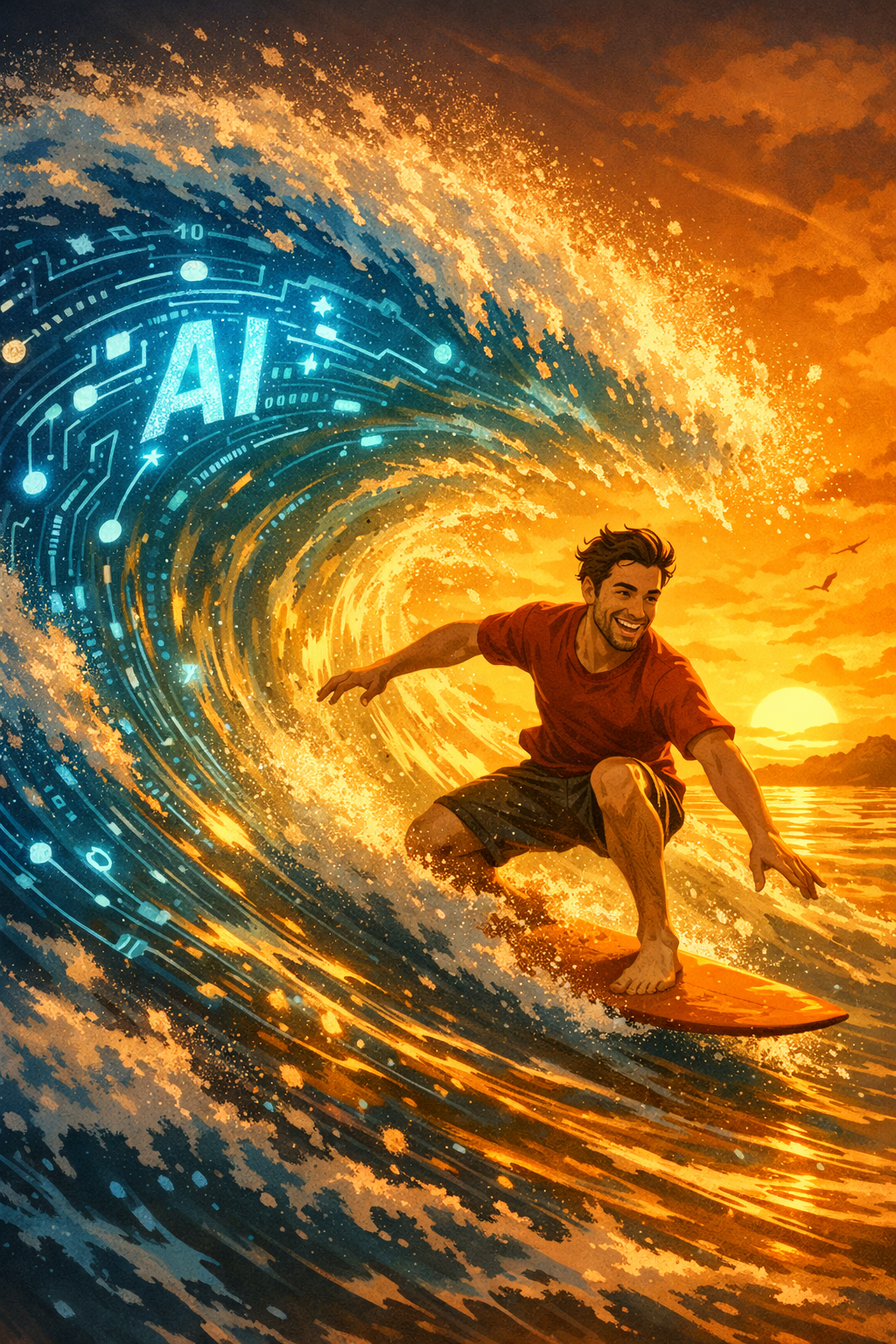
We’re betting you see the wave coming and you’re ready to learn to surf it—because trying to hold it back was never an option.
The choice is still ours. But the window is closing fast.
What will you do with the time that remains?


Leave a Reply