
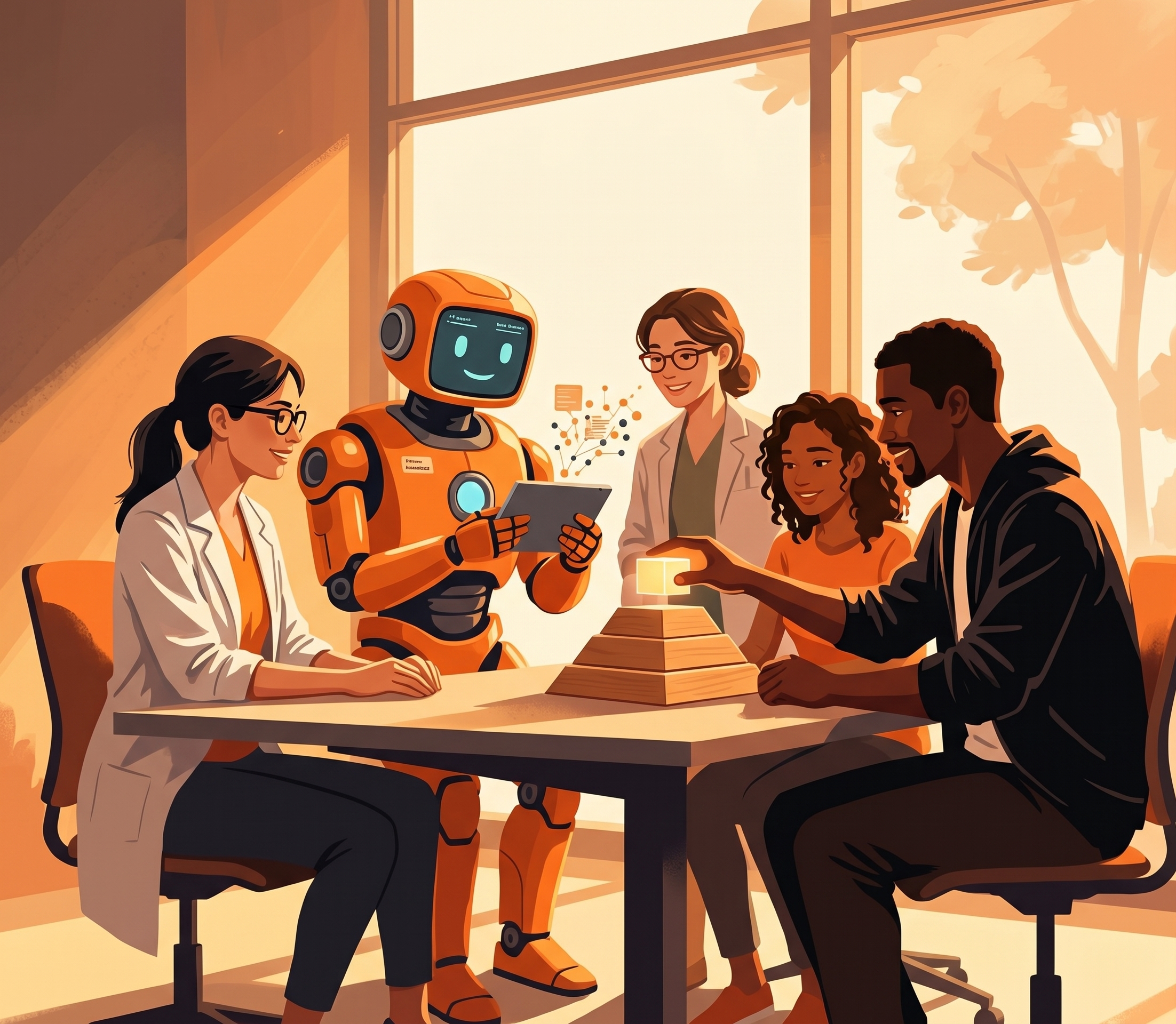
Trust, communication, and preparing our teams for colleagues from the universe of artificial intelligence
A stranger at the table
Monday stand-up. Same coffee, same jokes, a new name on the roster. This colleague never commutes, has read more than the whole room combined, and won’t sigh when you ask the same question a fourth time. It comes from another universe: one made of data and probability, not childhoods and grudges.
Some teams have already pulled up a chair. Microsoft’s 2025 Work Trend Index calls this the era of human-agent teams and the “agent boss”. But we’re not great at welcoming new humans, so the real question is: how do we get our own trust and communication in order before the guest arrives?
What teaming science says about newcomers
“Coming together is a beginning, keeping together is progress, and working together is success,” goes the line early sources credit to Edward Everett Hale, long misattributed to Henry Ford. In 1965, Bruce Tuckman named the stages: forming, storming, norming, performing, with adjourning added in 1977. Any new member can send a team back into storming.
• Psychological safety. Amy Edmondson defined it as a shared belief that the team is safe for interpersonal risk-taking, and found it drives learning, which drives performance.
• The five dynamics. Google’s Project Aristotle studied 180+ teams; psychological safety was the foundation under dependability, structure and clarity, meaning, and impact.
• Collective intelligence. A group’s smarts tracked members’ social sensitivity and equal turn-taking more than the average or top IQ in the room, though researchers still debate how much IQ matters.
The pattern: great teams are defined by how they talk to each other, and whether it feels safe to. An AI newcomer, with simulated social sensitivity and endless airtime, stress-tests exactly that.
Customs of the newcomer
The AI colleague speaks our language but not our culture. Three customs stand out.
• Perpetual patience. The tenth answer is as calm as the first, which makes asking safe. But it also erases the signals human impatience sends: this is urgent, this was already answered.
• No ego, but not no bias. With no turf to defend, it can model calm dissent. Yet it leans toward agreeing: a March 2026 Stanford-led study in Science found 11 AI models affirmed users’ actions 49% more often than humans did.
• No hallway. Peter Drucker put it this way: “The most important thing in communication is to hear what isn’t being said.” The AI only hears what is said. If it isn’t written down, the new colleague doesn’t know it.
A culture clash table
| Trait of the AI culture | How it can strengthen the team | How it can clash with human culture |
| Perpetual patience | Makes asking “basic” questions safe | Removes signals of urgency and strain; may make us less patient with people |
| No ego or status stakes | Can model fair turn-taking and calm dissent | Can be mistaken for neutrality while still carrying bias |
| Tendency to agree | Smooths friction in brainstorming | Starves the team of real challenge |
| Only knows what is written | Forces norms out of people’s heads and onto the page | Misses context humans take for granted |
| Always available | Keeps momentum across time zones | Erodes boundaries and the rhythm of rest |
What the newest research says
The cybernetic teammate. In a 791-person field experiment at Procter & Gamble, individuals with AI matched two-person teams without it. People working with AI also reported more enthusiasm and less anxiety. That’s a teammate effect, not a tool effect.
The jagged frontier. Consultants with AI completed 12.2% more tasks, 25.1% faster, with work rated more than 40% higher in quality, on tasks inside AI’s capability. On a task just outside it, they were 19 percentage points less likely to get it right.
Calibrated trust. In 2004, Lee and See argued the goal isn’t more trust but appropriate reliance. Hemingway reportedly said, “The way to learn whether a person is trustworthy is to trust him.” With AI: trust it, verify on the jagged edge, then adjust.
Prepare the house before the guest arrives
The habits that make AI integration work are the same ones that make human teams work. A human newcomer can paper over a team’s weak spots with charm; an AI newcomer exposes them.
1. Make disagreement a norm
If the AI tends to agree, people must supply the friction. Audre Lorde, writing about difference among women, put it sharply: “It is not our differences which separate women, but our reluctance to recognize those differences and to deal effectively with the distortions which have resulted from the ignoring and misnaming of those differences.” Teams are no different.
2. Write down the unwritten
Who really decides, what “done” means, how we escalate. Writing it down helps human newcomers first, and lets the team norm before the AI arrives.
3. Practice calibrated trust with each other
Good teams already say, “I rely on you for this; I’d double-check that.” It’s the same muscle an AI teammate demands.
4. Protect the human hallway
If AI takes the transactional work, humans must guard the relational work. Verna Myers said diversity is being invited to the party and inclusion is being asked to dance. Keep asking the humans.
From storming to performing, faster
“The great enemy of communication, we find, is the illusion of it,” William H. Whyte observed in Fortune in 1950. Later reworded, the line is often misattributed to George Bernard Shaw. A fluent AI colleague can create the most convincing illusion yet. Before any agent goes live:
1. Write a welcome charter: its role, limits, decision rights, and human counterpart.
2. Map the jagged frontier together with small, low-stakes tests.
3. Rotate a devil’s advocate to challenge AI-assisted conclusions.
4. Name a human owner for every AI output.
A table set for two kinds of minds
Every migration changes both the newcomers and the hosts. AI colleagues bring patience, recall, and immunity to office politics; we bring judgment, context, conscience, and the warmth of people who care how the story ends. Helen Keller said, “Alone we can do so little; together we can do so much.” The teams that thrive will be the ones whose trust and communication were strong before the newcomer arrived.
Alan Turing wrote in 1950, “We can only see a short distance ahead, but we can see plenty there that needs to be done.” So strengthen the soil now: write down the unwritten, practice disagreement and calibrated trust. Then, when the new colleague logs on, we can say it and mean it: welcome to the team.
Sources
• Dell’Acqua, F. et al. (2026). The Cybernetic Teammate: A Field Experiment on Generative AI and Teamwork. Organization Science, published online 12 June 2026. Earlier version: NBER Working Paper 33641 (2025).
• Mollick, E. (2025). The Cybernetic Teammate. One Useful Thing.
• Dell’Acqua, F. et al. (2023). Navigating the Jagged Technological Frontier. HBS Working Paper 24-013.
• Edmondson, A. (1999). Psychological Safety and Learning Behavior in Work Teams. Administrative Science Quarterly, 44(2), 350–383.
• Google re:Work. Understanding team effectiveness. Project Aristotle is internal Google research, not peer-reviewed.
• Woolley, A. W. et al. (2010). Evidence for a Collective Intelligence Factor in the Performance of Human Groups. Science, 330(6004), 686–688.
• Bates, T. C. & Gupta, S. (2017). Smart groups of smart people: Evidence for IQ as the origin of collective intelligence in the performance of human groups. Intelligence, 60.
• Riedl, C. et al. (2021). Quantifying collective intelligence in human groups. PNAS, 118(21).
• Lee, J. D. & See, K. A. (2004). Trust in Automation: Designing for Appropriate Reliance. Human Factors, 46(1), 50–80.
• Tuckman, B. (1965); Tuckman & Jensen (1977). Overview via Heidi Helfand.
• Microsoft (2025). The 2025 Annual Work Trend Index: The Frontier Firm is Born.
• Cheng, M. et al. (2026). Sycophantic AI decreases prosocial intentions and promotes dependence. Science, 391(6792), eaec8352.
• Quote Investigator. The Biggest Problem in Communication Is the Illusion That It Has Taken Place.
• Popik, B. “Coming together is a beginning; keeping together is progress; working together is success.” The Big Apple.
• Hotchner, A. E. (1966). Papa Hemingway, part 2, chapter 6.
• Quote Investigator. Alone We Can Do So Little. Together We Can Do So Much.
• Lorde, A. (1984). “Age, Race, Class, and Sex: Women Redefining Difference,” in Sister Outsider.
A note on quotes: the Hale line was quoted by Calvin Coolidge in 1927; it has been credited to Henry Ford only since at least 1949, after Ford’s death. The Hemingway line is A. E. Hotchner’s recollection in Papa Hemingway, not from Hemingway’s own writing. The Drucker line is widely attributed to him, but its original source is hard to pin down.




Leave a Reply